


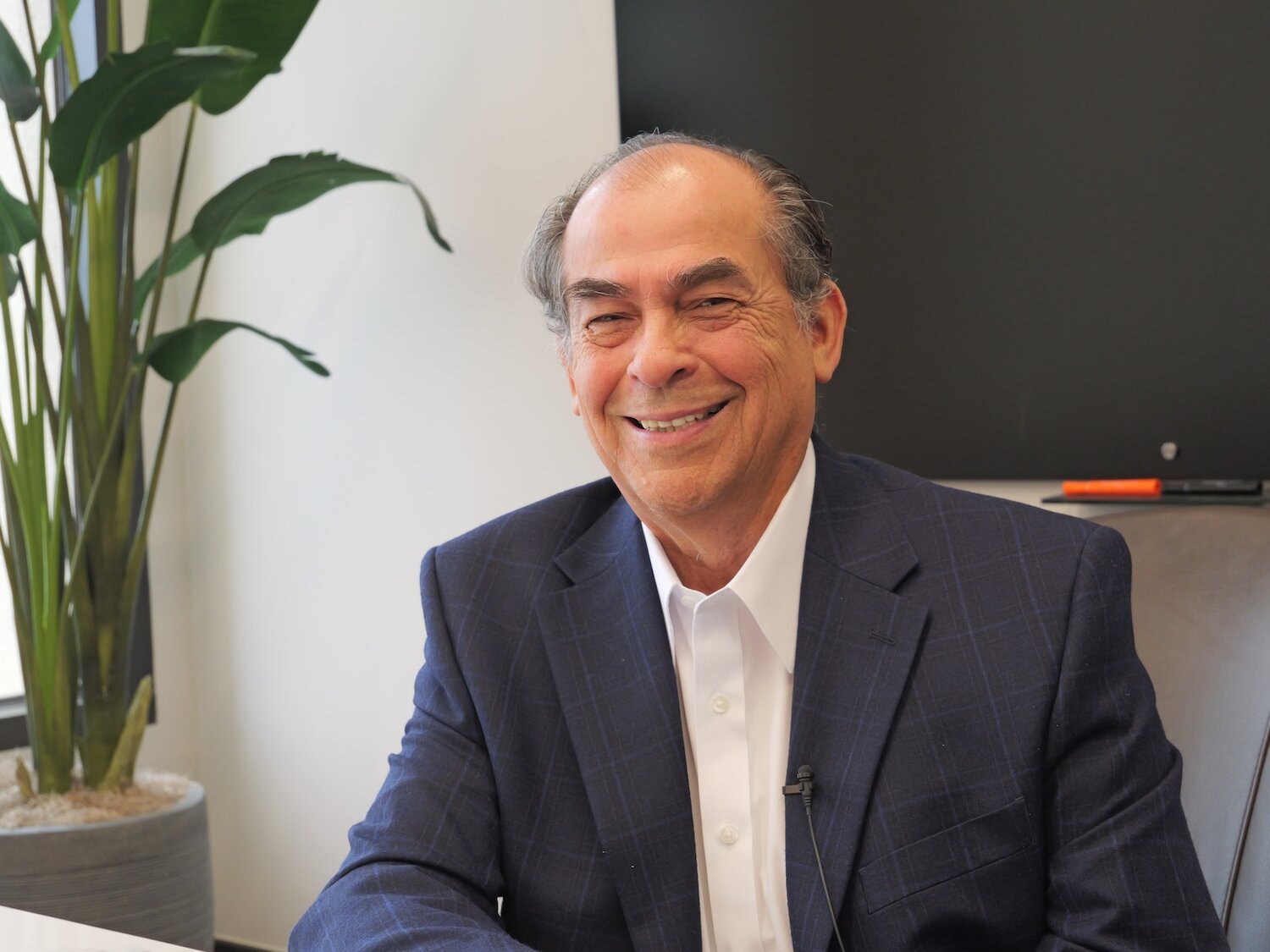
McALLEN, Texas – A recent news report tallying $110 billion in incoming industrial, energy and data center investments across the Rio Grande Valley significantly understates the true economic impact heading to the binational region, according to the executive director of RioPlex.
In an exclusive interview with the Rio Grande Guardian, Mario Reyna said the widely circulated $110 billion figure fails to account for the economic multiplier effect—secondary and tertiary spending that he estimates will generate an additional $40 billion to $80 billion in regional economic activity.
"You might have read an article about the number of investments that are coming into the region. It's an incredible number, something like $110 billion," Reyna said. "But one thing that the article did not mention is this idea that we call the multiplier effect. You invest $1, then it multiplies. So the analysis that I did with AI said, 'What do you think is the multiplier effect if someone invests $110 billion?' Well, it's like an additional $40 billion to $80 billion more."
Factoring in the minimum multiplier alone pushes the total economic impact to at least $150 billion—a figure Reyna noted surpasses total foreign direct investment flowing into the entire nation of Mexico.
"The amount of money being invested in this region is more money than is being invested in Mexico, the whole country," Reyna emphasized. "That's the big number, by the way."
The news report was published in a publication called MySA.
Beyond the multiplier effect, Reyna argued that initial capital investment figures reported in the press routinely underestimate what companies ultimately spend once construction begins and projects scale up.
He pointed to major developments already underway or announced across South Texas, including liquefied natural gas (LNG) export terminals, a $24 billion xAI data center project near Starbase, wind-powered data center infrastructure in Willacy County, and Saronic Technologies' amphibious vessel manufacturing operation ("Port Alpha") at the Port of Isabel.
"A lot of the data centers invest a significant amount of money—not necessarily what is reported, but once they get going,they just get going," Reyna said. "The one that's heavily reported is the one in Starbase, for example. It's $24 billion, and it's $24 billion because they're going to put a power plant there. So, imagine all the other data centers; they're going to do something similar. The one being reported for Willacy, it's going to have its own power. It's going to be wind energy, but they're going to do it."
Reyna drew a direct parallel to the region's LNG buildout, noting that initial project announcements expanded substantially over time. Similarly, he agreed that defense contractors like Saronic—which secured a major government contract to build autonomous amphibious vessels at Port Isabel—are positioned to land follow-on federal contracts and potentially expand into commercial markets.
"A lot of those initial investments will grow, just like the LNG started to grow," Reyna said. "They started with an amount, and they got bigger and bigger and bigger. The way I look at the investments, and the way I have read other investments from around the state and the country, they start at one point and they just keep adding and adding and adding."
Reyna spoke with the Guardian following appearances at the Women Economic Forum at the McAllen Chamber of Commerce, where he addressed community skepticism regarding the resource demands of massive data center developments.
He pushed back against social media claims that data centers will deplete local municipal water supplies or strain the regional power grid, explaining that modern facilities utilize closed-loop cooling systems and bring dedicated power generation online.
"One example that I gave today at the Women Economic Forum is I said to them, 'All of you have a car, and when was the last time you put water in your radiator?'" Reyna said. "The meaning of that is that a lot of these data centers are closed-loop. You put water in one time, and that's it. There's a lot of what I consider noise scaring people that they're going to take all the water away. No, they're not. And they're concerned about the power—they're building their own power sources."
Reyna urged Valley residents to look past online speculation and examine project specifications directly. "I think we need to put the public at ease about these data centers. They need to go do their own research, but do real research. Don't just rely on social media," he said.
To ensure local residents capture the high-paying jobs tied to this wave of capital investment, Reyna said RioPlex is convening regional educators, business leaders and elected officials for an upcoming summit titled "RioPlex: What Comes Next?" on Dec. 1 at South Texas College's Mid-Valley Campus in Weslaco.
While out-of-area contractors will handle much of the initial construction phase, Reyna stressed that South Texas school districts, community colleges and universities must align their technical training programs now so local workers are ready when data centers, refineries, LNG terminals and shipyards become operational.
"We didn't know about this article that came out today, but in our thought process, we know this is coming, and so we need to get ready to handle those huge investments," Reyna said. "We need to see what type of jobs are required in data centers and make sure that we have the right programs. We need to see what kind of jobs are required by LNG to make sure we have the right programs—same thing with the refinery, same thing with the boat-making operation."
Reyna added that the Dec. 1 summit—which has already sold out its in-person seating and will be livestreamed to the public—will feature Hidalgo County Judge Richard Cortez, CIL President and RioPlex Chairman Joaquin Spamer, Rio Grande Valley Partnership President Paco Gonzalez, and local digital infrastructure executives outlining how the binational region can transition from an agricultural economy into a North American industrial powerhouse.
"It just makes you believe that we have finally arrived at the right economic level so all of us can continue to prosper," Reyna said. "I'm just hoping that the public sees this kind of news as positive as it is."


